
Design starts before the interface
Agents can compress weeks of product review by exposing gaps in a loose brief before anyone commits to a polished interface.
Read the snack ↗ IntelligenceSnacks
As agents absorb more operating work, a firm's ability to own and move its encoded processes becomes a condition of business control. AI can accelerate each employee’s workload while leaving the business’s repeated processes and handoffs untouched.


With Pete Winn, Andy David and Jarrad Grigg
7 ideas developed from this conversation
About this conversation
As agents absorb more operating work, a firm’s ability to own and move its encoded processes becomes a condition of business control. AI can accelerate each employee’s workload while leaving the business’s repeated processes and handoffs untouched.
Explore this episode’s connected ideas
Agents can compress weeks of product review by exposing gaps in a loose brief before anyone commits to a polished interface.
Read the snack ↗
AI can accelerate each employee’s workload while leaving the business’s repeated processes and handoffs untouched.
Read the snack ↗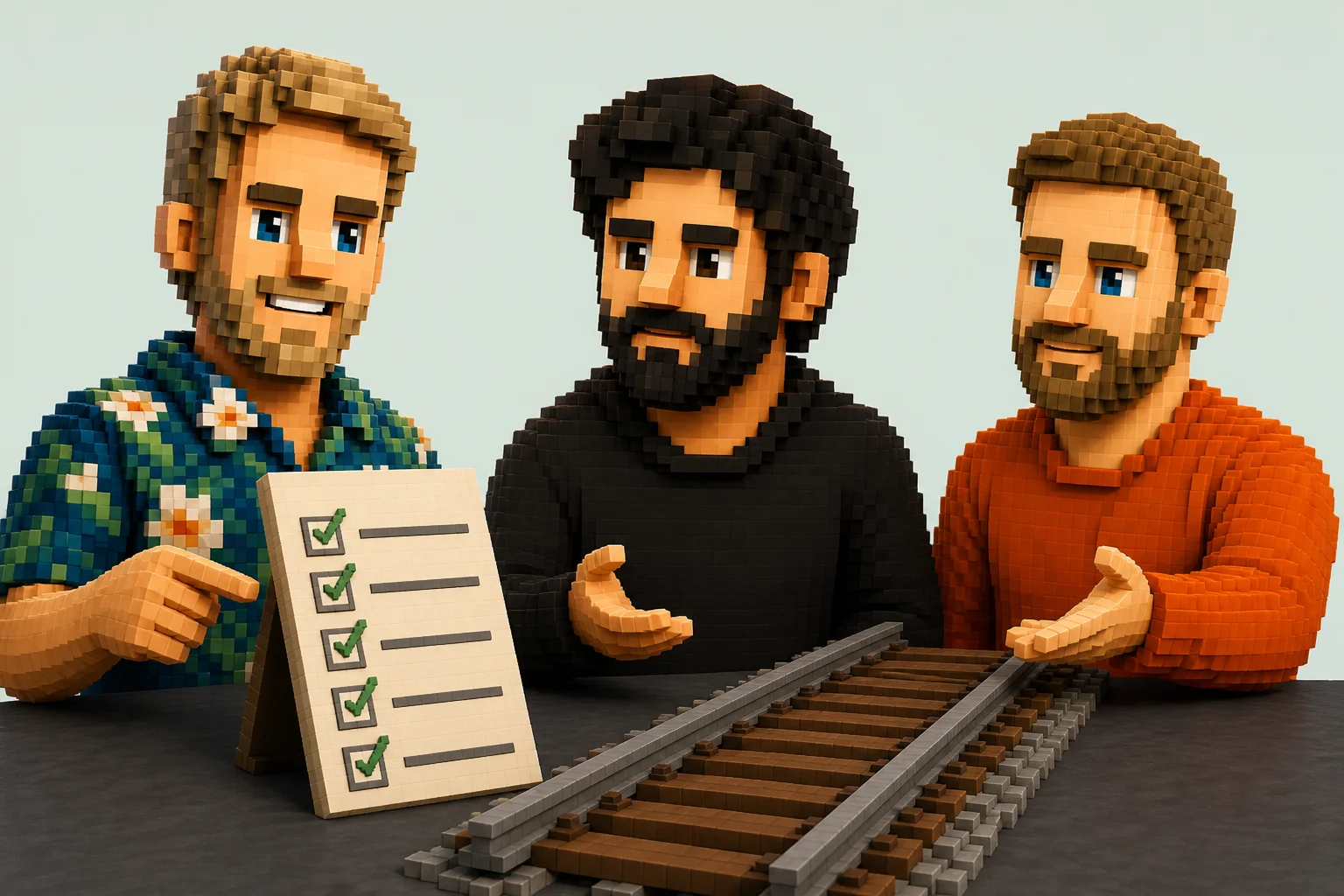
Reliable execution comes from making required checks part of the process, rather than instructions that a person or agent must remember to follow.
Read the snack ↗
The next leap in business automation will come from turning capable models into reliable parts of an operating system.
Read the snack ↗
An agent workforce can automate a great deal of activity while still losing its cost advantage to software that delivers the same outcome with less supervision.
Read the snack ↗
As agents absorb more operating work, a firm's ability to own and move its encoded processes becomes a condition of business control.
Read the snack ↗
A firm can turn accumulated judgement into an owned asset by encoding how it works in private instructions that agents can use.
Read the snack ↗The complete source conversation, lightly formatted for reading.
All right, welcome to the, I was going to say the big stuff, it's the good stuff, the good stuff, the big episode 53.
This episode is actually, it's too powerful so we can't broadcast this one unfortunately.
It's only going to be available to a small group of subscribers in projects, I don't know, sand wing.
It's going to be reserved for 100 days for a view.
Yeah, exactly, just to make sure.
It's probably going to crack all of your passwords.
There's going to be so much alpha in this one.
I do think we should cover some of the mythos though.
I think it's such bullshit.
Alright, welcome to the pod.
There's obviously three of us around the campfire today
as we sit in the van at the glorious city beach.
It's just raining today, so less background noise, which is good.
But welcome back to the pod, Jared Grigg.
Hello.
How you going?
It's good to be here.
And I'm in the van this time, so I'm very happy.
You're doing it properly this time.
You get a full experience.
Yeah, I'm loving it.
You're jealous of Deadman.
Last time was almost too formal for the good stuff.
It was in this plush room.
We had mirrors.
It did look a bit like a sex room.
Yeah, there were mirrors all the way around us.
It's like velvet sofas.
It's not that kind of podcast.
It's the karaoke room.
That's a different podcast.
That's the big stuff.
This is why you keep using the tape, obviously.
It's like, which one am I recording today?
What's the thumbnail going to be?
OnlyFans slash big stuff.
That probably is an OnlyFans.
Yeah, probably.
That's Noz.
Well, it's not me anyway.
I can't speak for you guys.
Welcome back.
Yeah, it's good to be back.
A lot's changed.
A lot's happened since the last pod.
Yeah, it's been a crazy, crazy world at the moment.
It is a crazy world.
Yeah.
So, I don't know.
We'll just see where this conversation goes.
I don't know where you want to start.
Well, should we start?
I wouldn't mind covering Mythos because I think that's an interesting thing.
and that'll probably lead us into a bit about, you know,
how you should think about your reliance on these companies,
more so than the models, I think so,
and how much of your business you want to give up.
We had some good conversations yesterday with a friend of the pod, Gabe,
which was interesting.
And then I'd also just want to hear about where you're at
and what you're up to these days because you've moved on
and started a new thing, so I think that's worth discussing.
Also, where you've changed mine since your last time.
I think like
we've changed our minds
on a bunch of things
like we changed our minds
and changed them back again
in some cases
so yeah
I'd be curious about that one
as well
I like that we've
framed out the pod
ahead of
you keep telling me
we should do this
it's good for the
the listeners
understand what they're
going to learn
those listeners need to know
what's coming out
sometimes we just start
doing whale watch
right at the beginning
and we've lost
like everyone
dolphins
you can see it like
it's like what you see
is like a small
black thing
Just like on the wave, and then all of a sudden they'll be like,
I'm like, Dolphins will.
It's nice.
I think the listeners enjoy us describing things that they will never see.
I need to fill that in, don't I?
I was listening to Gigi last.
He just did a No Solutions with Justin this week that dropped.
And he said, you know what, maybe I'll add a GoPro to my ankle
so you can sort of see where we're walking.
I thought, that's interesting.
Maybe we could do it because the first time we did this,
the initial pilot, we actually just filmed the view.
And the idea was you'd see, I think we sat on the bed at the back, we'd lay down either
side, not in a spoon or anything.
It wasn't the big stuff.
It wasn't the big stuff, didn't we?
And we just had a video, the camera pointing straight out the back and recording the sea.
But the problem is, obviously we're at a public beach, just tons of kids wandering around.
I was like, he can't, he can't do this.
It's exactly how I imagined that you're both just sitting there looking at the beach talking.
No, and he looks at the car park, he's weird.
He can, he can sit there.
Yeah, it's true.
Sideways.
Anyway, Mythos.
Yeah.
Mythos is so dangerous that we're all fucked
and everything's been cracked.
Thoughts?
Hyperbolic.
Just a tad.
I think there's an element of marketing spin for this, for sure.
It's an element.
Yeah, I mean, they did this with the early versions of GPT as well.
Number two.
Yeah.
Number two is so powerful it could not be released.
Number five is so powerful it could not be released.
And I think that people are now sort of catching on to this.
And I think it's justifying a share price and trying to get more capital.
But I'm not saying it's not going to be a great model.
It's probably going to do a lot of amazing things.
I think you'll be like 5% there.
Yeah.
Is it going to be Ultron?
I don't know.
And it just definitely feels to me.
My view on this now, which is, you know, we can go down the hole.
Like, I'm moving towards more sort of, I want local.
I want my own models.
because I'm starting to see these big companies now sort of centralizing.
This is the most powerful model that we've got.
It's so powerful it's only available to the biggest companies in the world,
the deep pockets.
And they're starting to sort of tier intelligence
and give access to the people that spend the most
because they're a for-profit business.
And this is kind of their, it feels like the way that it's going.
And I've seen this even recently with the models,
is they feel nerfed, right?
Like you're using them.
They've deliberately.
Yeah.
It feels like we had,
we had that week of like double usage or whatever.
And then it feels like when they pulled it back,
they pulled it back even further a little bit in terms of every,
every six months,
like they make Claude a retard.
You feel it.
They'll stay monetized.
Absolutely.
Even with like the,
the,
the,
the effort,
right?
You can,
you bump the effort back up to high and you,
you do what you used to do and it's just not the same.
And it's,
it's so,
it's hard to,
I mean,
there have been people that have worked this out,
you know,
they've got reports on it,
but for me,
it's more of a feeling
because it's like working with a person.
I said this last time.
It's like,
why does he come in to work drunk all of a sudden?
Yeah, let's go.
He's still okay,
but he is drunk.
And lazier.
They don't follow the. . .
Yeah, so I definitely feel that
and in recent times,
I've been trying to. . .
I've been experimenting
with a lot more local models
like Gemma 4
and going on a hugging face
and finding fine-tuned,
optimised models and stuff.
They're not there yet, but I feel like they're six months behind Frontier stuff anyway,
so maybe by July-ish we'll have the Opus 4. 5 capability running on a Mac Studio or something.
I don't know.
Maybe, yeah.
I don't feel like I'm short-term bullish on local models just because they're. . .
My experience of trying to run them. . .
I went and bought a reasonable hardware, like a top-end Mac Mini,
And then I instantly thought, oh, I was lied to.
This isn't good enough to run anything.
I can still only really run maybe up to 20 billion models
or whatever it hits about 20 gigs of memory,
and that's the only thing I can do on it.
And then it says you can't do anything else on the machines.
But it's very useful as a permanent harness.
My always-on survey holds all the data, holds all the graphs.
All of my stuff is on there,
but I still just use then agents that call out the other models.
So I think there's this component of,
If you actually want to go down the local,
you really are going to have to go buy proper hardware
and do it properly.
I don't know.
Deadman's done a bunch.
He just had a bunch of GPUs from the work.
So he's used those.
But it feels like that's a bit of a myth on Twitter
at the moment.
Yeah.
That's that great.
And Playmogjam at four.
I had a similar thing.
I went and got a few of the quantized ones.
I was like, it's better.
Yep.
But it's just so much worse than just. . .
Even go into like a Kimi K2. 5 that's hosted some Royale.
I would still just do that because that's so much better and quicker
than doing the Gemma stuff.
So I think it will come.
I agree.
And the context window fills up so fast.
They're just good question and answer machines locally.
And I just use it to not use as much usage in my subscription plans.
I wouldn't use it in anything production yet.
But an interesting idea to run it as like a harness for the other agents.
I also think that the models don't have to be that intelligent.
I think we keep assuming we need more and more intelligence in these models.
And I think our view, this is what we're reflecting in there,
the predictions for this year was it's not about models getting that much more intelligent.
It's about the harnesses and the agents and systems
and the processes that you put around it getting more intelligent.
And I think what you need to run a business is
your agent needs to be clever enough to write some software.
And the software doesn't even have to be flashy.
It just needs to be like CLIs and scripts
that move data from one thing to the next.
And then you need it to be clever enough
to reliably transform stuff between different JSON shapes,
which is like kind of like what you do in. . .
It's like you've got to make a decision.
You've got to be able to move data from one system to another system.
That's kind of what we use a lot of humans for in the workplace.
And then it just comes down to implementation,
actually getting the thing embedded.
Yeah, yeah.
I think about it from like a small business perspective, right?
Like that's what I'm trying to do now is help small businesses with this sort of stuff.
And like you guys are.
And the two kind of barrels I'm staring down is do you, as a business, do you go all in on a provider like Anthropic and jump into their ecosystem and use all the great tools that they have?
Or do you try and move open source, local, you know, some box that you have in your office that's yours and your data?
And I know what most businesses would prefer.
They want the local.
They want something that they feel like they have control over their data.
But the, you know, Anthropic cloud provider is so convenient.
This is the exact conversation that we had yesterday.
I'm not sure.
Yeah.
Yeah.
No, I mean, my personal view is I think everyone will say they want private.
Yeah.
And then we'll select Anthropic.
Just like they select Google and Microsoft.
And, you know, our data is always sacrosanct and we need to keep it private,
but we feed it all through Microsoft anyway.
They do it anyway.
So, yeah, I don't know.
I also think if you're like helping small businesses,
ultimately I don't think they're going to care.
They will just want consistency in the output.
And so that's where like people like us need to make these decisions.
Like which models do we embed where?
And are you essentially agnostics that you can switch these things as you need to
when Anthropic comes along and goes, yeah, we're going to nerf this today.
Exactly.
And yeah, but I don't think businesses are even thinking about this question at all.
I think the easy thing is just to go, well, Anthropic's there.
Let's just use Claude Cowork for everything.
And off you go.
Yeah.
This is the conversation we gave yesterday.
We were talking about if you project forward to what your business looks like in five years,
it's going to look quite different to how it is now.
And you're going to have a group of people that observe this business that runs.
And a lot of the work inside the business is going to be done by very custom software
with agents stepping in and the bits where you need them to step in to make decisions,
push stuff forward to transform things to highlight things to review things like all of those things
that the agents can do and they're going to push up to this like layer of humans over the top and
like that system of like the software and the alerts and everything else in there that's really
like that is the definition of your business and you can build that in several different places
like you could have it all inside Claude Cowork you could have it all inside like a set of like
workflow scripts you can have it all inside like custom software that you have and like where you
decide to build that system is going to tell you like who really controls your business because if
you put the whole thing inside Claude you're switching costs that you can't you will never
leave Claude you'll be stuck in that model for the rest of your life and effectively they can turn
your business off by turning off provision of your business and you won't be able to move everything
quick enough somewhere else to go and do it so it becomes very like because the the question we had
is like we were talking to gabe about the wingman stuff and it was all about why is wingman open
source why are you not charging your license fee for this and i said i morally can't charge you a
license fee for this because what i'm saying is that you should use this suite to define all the
business processes of your business that's your business it's not my business therefore you need
to be able to own that if i get hit by a bus and andy wins the lottery for some reason andy came
really good on that one.
I mean, I'm sorry for you.
Or Andy gets here by the bus
and then I win the lottery
and I'm like, oh, well.
You know, it could go either way.
Who knows?
Who knows?
But you still need,
you need your business to operate.
So like, if it's like now
dictated by a license fee
that I can do,
then I become the extractive part of that.
So that's not what we should do.
Like, that's the wrong way
to develop all small business
in the world
is that they should be owned by Claude.
That's fucking ridiculous.
We don't need to do that.
We shouldn't just go
and opt into that world
without thinking about it.
It feels like what they're shooting for.
Yeah.
I'm sure they want that because they're evil.
Like people that constantly tell you that they're evil,
you can just listen to them and say,
oh, the guy that keeps doing all the evil stuff
and lying about everything and trying to get
like regulatory capture, like that's what he's trying to do.
Like, oh, that's probably why he keeps doing it.
But it works for Microsoft, right?
I mean, this is part of the problem
because like a lot of this decisioning
is done by the business.
Gabe like is an outlier.
I mean that in the most positive way possible.
He's experimenting heavily with this stuff.
He's really thinking about how he should be rewiring the business.
Most small business owners are going to be abdicating this decision
to their people inside the business,
and then they're all going to just start using Claude Cowork individually
to help them do their jobs faster.
That's not, let's think through how we use these models
from a systems design perspective
to actually not have to do the work again and again and again.
That's just the individual has a bunch of work,
and I'm going to continue doing the work.
I'm just going to do it a bit faster with Claude Cowork.
And so there is like a huge like advantage you can get from doing the formal, which is just going out and rewiring all this stuff.
But you have to, as the business owner, like take some responsibility there.
You understand right across the business, right all across the different divisions in the business, you understand how those function.
If you abdicate that to the individuals inside the business, they're going to understand their function really well.
But they're maybe not going to have the oversight of how it interrelates with the other ones.
Yeah, it's an interesting point, isn't it?
like that's that phase that I think most businesses go through
where they just do what they've currently done
just a little bit faster.
A little bit faster.
Right.
And the individual gets more time
and I think it'll take a while to catch on to realise
you can just retool the whole business.
There's whole maybe departments you don't need.
You know, I'm not a fan of, you know,
the loss of labour and people losing their jobs.
I actively sort of despise that
but I think a lot of people are going to have to learn
new ways of doing things
rather than just do what they do faster.
And so it's like a whole other challenge for business owners to get their head around.
But the point about the model there as well that's really interesting is like,
I think for a lot of people, especially on Twitter, it's like, just throw intelligence in everything.
Yeah.
And it's like, well, you don't need to do that.
You know, most of what you do inside the business is deterministic.
You have rules and processes and systems there to basically define how people do those things.
It's the same kind of thing.
You don't just go like, let me hire like 20 people tomorrow and just let them run right in the business.
know they come in you onboard them to have a bunch of systems yeah exactly you
can't scale with more people in the same way you're not gonna be able to scale
with just a million agents it's gonna be too much a lot of those you have to
manage points inside those processes can be done by you know like they don't need
frontier models yeah yeah true yeah and that's the way I've kind of structured
things as well at the moment my business is like depending on the need I'll use a
different tier of model and to your point I just constantly go for the top end ones
Yeah, I do until I run out of my credit limit super quick, right?
And I can't be bothered paying the API costs.
But yeah, to your point about just throwing 100 agents at it and being hard to manage,
I've been experimenting a lot with Paperclip.
I'm absolutely loving it just because of the experience of it.
It feels familiar and it feels easy to use.
I quite like it.
But every single one of the agents that I've got my CEO has hired,
they're all doing their own thing on a regular basis.
And not only are they using a lot of token budget, but I have to manage them all.
I have to constantly check on what they're doing, right?
So there's like a bandwidth limit to what you can do with those throwing agents and things.
The answer, it turns out the answer isn't agents.
We've been talking about this concept of service as a software.
Whereas, look, you can always throw people at it or throw agents at it in the same way you could always throw people at something.
But what we'd realize is that if you have a business where you need 200 people to do something
and somebody else has a business that's software-based that has five people that do the same thing,
this business dies.
And the same is true with agents.
If you have a business that requires 200 agents to do it and they're all running in paperclip
and they're all automating and stuff, it doesn't matter.
Because somebody else can build the same thing with software and they outpriced you.
So it's like this ability to throw agents at it that solves the person problem is still incorrect.
it's not the end game of the whole thing
it collapses back down into software
the difference is
we could only, like five years ago
we could only provide software at a global scale
that is kind of okay
and that's how we built software
because we were limited in our ability
to produce code and we're not anymore
and so what you're going to have is all the software
is going to be written at a local scale
and it's just going to do only what it is required to do
I think a lot of UIs
go away, I think so much more stuff
just becomes CLI based scripts.
It's like there's no, it's so useful to be able to say,
okay, I'm going to write a bash script that just calls that,
pipes it into this, does that, pipes it into this.
And then all of these, like, you think of like the amount of fucking
hundreds of millions of dollars that have been spent by like,
on these like just integration tools.
Like they go, okay, I can get that API and I can move it over here into this.
Yeah.
It's like that's now just like this one's got a CLI, this one's got a CLI, and this is just a bash script.
And it can be created at runtime based off what the CLI can do.
This is why MCP is kind of dead.
MCP has to execute inside the agent's session, and it can only do one thing at a time.
And then it requires more API calls and more intelligence to figure out, okay, how do I move that from that?
It's like, no, no, CLI.
I already know what that's going to output.
I know the shapes I'm going to get back.
So I can just create a script that does the whole thing in one hit.
So now you're a model of the intelligence.
It's like, just write a single-use script.
I mean, they're not going to be single-use.
We'll just retain them and keep using them.
But you write a bash script that moves from that one, pulls it out, changes it, puts it there, moves it there,
puts it here, puts it there, bang, done.
And that was a thousand calls to Claude.
And that's how people are running it at the moment.
It's like, oh, I'll just. . .
And pray that it was some. . .
It's because there's a UI that you had to, you know.
It's the parlor trick of like OpenClaw we were talking about,
which I, you know, it's amazing what it did.
Yeah.
But it looks amazing because it does all this stuff
where it throws the agent and the intelligence at the problem.
Yeah.
But it's just not, you just wouldn't necessarily want to build
your business around that because in the same way that having an employee
where he does stuff slightly different every time,
you don't really understand what he does.
Somehow he gets a result, but every now and again,
he just turns up pissed.
Yep.
Like, you can't run a business like that.
You would go, huh, you know what I'm going to do?
I'm going to look at what this guy does,
and then I'm going to write it down,
and then I'm going to get someone stupider to do it.
Then maybe I'll put him on the next task.
But we're not, like, I don't know,
people haven't made that mental switch yet,
because I think it's so impressive what it can do
by just threatening the intelligence out of it.
Yeah.
Well, we've got a product designer here.
How are you thinking about UI in this context?
I think it's interesting, because, like,
I was thinking about this a couple of days ago,
because I've just rebuilt the clip generator
that we have for reels for YouTube.
We don't have many reels,
and that's why I developed a clip generator.
We have a lot more now.
Just spit them out.
Exactly.
But it's like,
I'm just going to say this,
it's very similar to that Opus clip.
I kind of was looking at their UI quite a bit,
and I was like,
it's quite clean, makes sense.
And then I got to a point where I'm like,
this should be ephemeral.
I should be able to set this up once,
and then never look at it again,
because it's useful,
but it's very visually oriented up front.
I don't want to have to go through the same pipeline every time.
Once I've set it up for this business, it's done.
And then the UI needs to shift.
Dump a video in a directory and have it just do it.
Exactly.
Then UI becomes more about auditability and accountability.
How am I able to assess how well this stuff is doing
before I then need to step back into that visual interface to make tweaks?
I don't want to always work in that space.
So I don't know.
How are you thinking about where UI goes?
Yeah, I mean, if we think back to the last chat,
I think what I was talking about was I didn't want to work in terminal
and I wanted this infinite canvas for exploration
before I sort of started, right?
My view has changed somewhat in a different way.
So I've realized that in this world,
you just have to move closer to the code.
It doesn't matter who you are.
If you're a product manager or designer or a C-suite executive,
you've got to learn the basics of this stuff.
and the closer to the code you are, the more effective you are, I think.
So I've just spent the last few months, maybe four months or so,
just diving into that world and it took something like Warp to really click for me.
Warp's like a different agent.
It's a terminal but it's an agentic terminal.
So the thing that always bothered me about working in that way was
it's all command-based and I have to remember the commands, right?
I'm a designer so I'm like,
we're going to type specifically this letter in this place to make it work.
But with Warp, I don't have to do that.
So that was my entry point.
I was like, this is great.
It kind of figures out what I want.
And then I started running Claude code in it.
And then I started running multiple sessions of Claude.
And from that point onwards, I was like, okay,
I'm starting to understand the workflow of how I can start in terminal.
Then where does the design piece come into that?
Where does the iteration of this infinite canvas?
You know, a designer typically would take some requirements from someone
or to have a meeting and then they've got this piece
and then they might just try and make it look good.
But I think the role of design in that way has shifted dramatically
where it's less about them, it's more about elucidating the requirements.
You have to understand what it is you're doing.
And that's the work.
I mean, the best designers I've ever worked with weren't.
They were always very good at making stuff look good,
but it wasn't the thing, if you know what I mean.
It was all about, okay, well, how do we go and figure out
what the opportunity here is?
What's the actual need that these people have that's underserved?
What actually is this product?
What needs to be presented?
That's the work.
And if you're bashing out rectangles in a Figma file
and you're calling it design, well, we've got news for you.
That's not design anymore.
You could argue it never was, right?
It's just a fake layer on top of the real thing, which is the code.
So designers have to move that way.
It's like in the same way.
I think coding was never actually the writing of the code.
That's just the syntax.
It's the thing that you had to do
because the computers didn't understand you
and you didn't understand it.
So we had this little interface language
that you could use to express what you were trying to say.
But again, the good coders, the good engineers, the good developers were always the ones that actually thought about the problem they were solving and how it was solved in a structured algorithmic fashion.
The code is just the output of that thought.
The code is just how you write that down.
Yeah.
It's like using maths to write down a proof.
Yeah.
That's all they were doing.
Exactly.
So, I mean, as now as a product designer, I've always, you know, for myself, I've never been super heavy on the tools because, you know, I've grown businesses and I manage people, right?
and more or less I've realized in retrospect
I'm basically just prompting people.
And so now I'm kind of subbing those out with agents, right?
And I've approached it like that
in terms of it being a collaborative exercise.
And so now what I've sort of built,
as you said before,
this is not like some crazy system that's just files.
I've got my own sort of private repository
for how I want to build things.
And I go through a process where I'm just talking to it.
I actually said last time on the pod as well
that I don't like talking to my phone.
Now I don't like typing.
I'll just use like whisper.
You start to realise how much more you can get out when you talk.
Because you'll type a prompt and it's like this long.
And then you speak it for like two minutes.
It's like all this and you're like, yeah, okay, I should do more speaking here.
Because I'm clearly articulating more stuff when I think it out loud.
Yeah, yeah, I've seen the light.
It's much faster and it feels a lot more natural.
My wife thinks I'm crazy because she just hears me speak.
She's like, who are you speaking to?
What's that? What did you say?
My computer.
Shush, I'm talking to wingman.
Yeah, that's right.
Get away.
So, you know, it's now a collaborative back and forth
of making the requirements piece right.
And I'm not going to jump into design
until I actually know what the hell it is I'm supposed to create.
Quick question then on the talking piece.
I love talking to the computer.
I don't like hearing the computer talk back.
Agreed.
It's too slow.
I can read text.
I want to read your response
and I want to see things that you produce,
but do not talk to me.
So the idea, because I thought maybe it would be about like, you know, having GPT voice mode type thing that open out.
Because it's good.
Like when you're in the car, you want to just chat.
It's fine.
It's good for that.
But I can't use it to fucking do anything.
Yeah, that's right.
It doesn't work.
Too slow.
Okay, interesting.
Yeah, completely agree.
And it's just all about bandwidth.
How fast can you get something down, right?
And that, for me, voice out, text back is the way to go.
And so like what a designer would do, right?
They might get like briefed by somebody.
And to be honest, most briefs are probably pretty average, right?
And in order to get that brief hardened, right,
you've got to go through, the typical way in software
is you take a loose PRD and then you just shop it around.
You get the QA people, you get the back-end engineer,
the front-end engineer, the product manager,
and they all get in a room and they all talk about it
and they go through everything line by line.
This takes weeks if you're doing it at enterprise scale.
Just a crazy amount of money.
And so, yeah, now I just have agents do it.
I've got all my agents set up with their abilities,
and I've just crafted it all as Markdown.
And so then they just duke it out.
They review the requirements.
They try to figure out where the gaps are.
I go through rounds of that until it's hardened sufficiently.
And my designer agent basically will, at that point,
create it as a. . .
It'll just do like a Unicode design.
So it'll just be like terminal kind of graphics
of what it could look like.
And then we'll riff on that from a design point.
I don't need to see a polished UI just yet
because we're still sort of figuring out
what's going on the screen.
And so that's enough as a draft.
and then when I'm happy with the requirements
so all the user stories and everything
my next stage is
okay what design program do I want to use
because I don't want stack agnostics
so I'm like well maybe today I feel like using paper or pencil
or figma or whatever
and then it just
the agents just pump out a draft in pencil
right
and generate the URL
okay I thought you meant pencils
oh no it's just like a program
it's just another one of these design programs
but it's agentic
so you know
I still haven't clicked a button
I'm talking to it, it'll create the UIs based on a design system
that I might have previously created.
So if I wanted to, to get better results in that infinite canvas. . .
So you would iterate on the design system instead of. . .
Yeah, I would dump in references.
Then what I would do is I'd use the agents in those programs.
Paper and pencil are both pretty similar.
Similar names as well.
But you talk to the program and you say. . .
Hang on, talk. Is that talking or is that a program as well?
All these generic names.
But I'll get it to take my references,
craft what a design system would be like from those references,
work on that.
Okay, now create a basic design system of that.
Typography, spacings, prompts.
Put all that on the infinite canvas.
And then by the time I've got those terminal UIs sort of down,
the agents, when they pump in the designs into that infinite canvas,
they use that as a reference point.
So now I've got something that's like half decent,
and I've still not clicked anything.
And at that point, that's when the design starts,
the actual refinement loop of tweaking this,
and you're not quite right, and drag that over there,
because all those programs do allow you to fine-tune it manually,
which I think is really important.
That's where the real experience of designer comes in
and makes it more unique.
Most people who would vibe code would just look at the first output
and go, oh, that looks pretty cool.
I've got my purple gradients and all the same sort of stuff.
They've gotten better at that.
I quite like purple as a color.
I always have.
It's a bit of a shame.
You can't anymore.
You can't use it.
I use orange and purple.
That's justifiable for other reasons.
I'm a very big fan of orange, obviously.
So that's kind of my new approach.
And at that point, that's still not the end result, though.
None of these design programs are still building the actual code.
But it gives it. . .
But you just knock that, like, three weeks of work.
Oh, yeah.
Basically.
Yeah, the PRD process now. . .
Like, I built a Flutter app on Monday.
full Flutter app using this process.
It took me three and a half hours.
I was ready to go.
And it looked good.
And I followed that process, right?
So it doesn't take that long anymore.
But you still have that human element with the experience of fine-tuning it.
So the design still happens.
It just happens in a different way.
And I think in a better way because as a designer,
you're thinking about what it needs to be and what it needs not to be
through that process.
There's always been this saying,
you should spend your time working on the business, not in the business.
Yeah.
I feel like that's very true in these
agentic worlds.
Buzzword, buzzword.
It really is about
if you're not getting the output that you want
it's probably because you're not spending enough time
thinking about how you would produce it
and breaking down the activities enough
and then giving enough reference material.
Often what you're doing is
as a human you kind of
I don't know
you work around
stuff
but if things aren't
clear you're then
going to insert a
whole bunch of
stuff from somewhere
else that you know
and you could just
write that down
get more repeatable
but we just don't
for whatever reason
this is going to be
really difficult for
people in businesses
though because it's
like this is like a
web2 byproduct where
we've just been like
throwing more and
more software that
is like human
dependent at
businesses it's like
oh we've got this
thing we need to do
let's go and bring
in another piece of
software and then
you know, Billy to go and like use that software, you know,
then that doesn't need 60% of what you need.
So you need to get another bit of software.
And so I think like for a lot of people,
there's been this deconditioning over time where they've just been so busy in the
business, they don't have time to think about what is going on,
on the business.
And so I think that's maybe going to come as a bit of a,
bit of a,
you got to build that,
those muscles,
you know,
after they've atrophied again.
I think the best selling piece of integration hardware in any business
that's ever been invented in enterprise was the swivel.
chair. How are you going to integrate this? Well we're going to put Billy in that chair.
Yeah he's going to do it. And on his monitor he's got two programs and that's how we've
integrated it. He's going to figure it out. We're going to be from any system to any system.
Well those two programs don't talk to each other. It doesn't matter. Billy's the interface.
He's the Zapier. The thing is they still don't. It's crazy. So if you can read the screen
then I can do it.
Yeah.
Do you think like,
sometimes I think about whether or not like,
like software is the right term when we talk about like,
you know, these processes just become software.
But I also wonder if there's just like too much baggage.
You need to call something else.
Yeah.
Because for a lot of people it's like,
oh God, we've already got so much software.
Yeah.
You know, it requires like most of our team
and sometimes we need to go hire more people
just to run this.
And then you go in and tell them,
business is just going to be software.
You know, then they're like,
oh shit, this is not what I'm after.
I wonder if there's like an optics problem there.
Probably, but I think it's. . .
Vibeware.
Yeah.
Then you're fighting against the equity of. . .
It's all going to be in a CLI.
It's like, oh, fucking hell.
What the hell does that mean?
It can't be too new.
Yeah, it has to be an incremental step change.
You could call them workflows, processes,
standard operating procedures.
Use the lingo.
Because I do think that a lot of it will look like
what you would define in a workflow system.
I don't think you need a human workflow system.
I would be more keen to use something like Temporal than I would n8n
because it's easier for an LLM to write Temporal because it's all code.
It's code first.
When it's UI first, it's much harder for an LLM to actually work with it.
I think it's even easier to just make it a bash script.
Isn't that funny?
Sometimes you just lean into the thing it knows.
the shape of work has changed so much
that I'll prefer something that's agent first now
than anything else.
This is how I want to work.
What you want it to be is closer to the bare metal.
Yes.
I think going back to where we started
on the conversation,
what you don't want to do,
the thing that's going to remain at the end of all this
is your business.
And your business is going to be a collection
of data, customers, processors,
and things that are all enshrined in software.
And you'll do a minimal amount of stuff
that you can get paid for.
Like that'll still live beyond the whole thing.
And what's going to matter is like where you define all that stuff and who owns it.
And so, you know, if you can get closer to bare metal in the sense that, all right, this is just a bash script.
Like you've got no dependency on anybody for anything like that.
You've got like everything from the operating system stack up.
You could just own.
And so nobody else can come in and take that away.
And I get that people don't think like this.
I think they'll be forced to more and more
because I think a lot of people
will just lose their businesses
because there's going to be so much
extractive pricing power from people
like Anthropic and OpenAI.
I mean, even there,
there's going to be competition between those. . .
I won't say the next word.
See, look how much better I'm getting.
The pricing. . .
Or am I self-censoring?
I've noticed the shift in the way
that businesses think about the cost of it too.
It went from a subscription
and on the balance sheet
subscriptions right and it got started to get quite high yeah i'm thinking why okay that's quite an
expensive subscription it's like no no all of a sudden it's labor replacement how much does an
engineer cost you yeah like well this is way less than that and you can do so much more so they're
just going to keep rising that bar the cost is going to keep going up i had this like discussion
with so we had justin moon on podcast a couple of episodes ago i think maybe like six nine months ago
he'd made i'm sorry we made a prediction he's like i think it's going to get more expensive
like we keep talking about how like this is all gonna get cheaper like i this is not my experience
with this i'm just spending more and more and more and more i agree and i think on an individual level
like once you see you spend more and more and then but you do like it's that's what i do is i go like
it's like i've got a 10 person software team and i don't have to deal with any of the
communication problems like i don't have to deal with any of the like talking back to me i don't
have to convince anybody to do anything but it just it happens and if when it goes wrong it's
because i'm not putting enough effort or focus on what i want it's an outcome at the speed of thought
yeah you know you can think it you can do it and you don't it's you've just removed all these layers
it's so convenient absolutely love it i will pay like if i if you if i could have got this level
of output from a software team for like a couple of days a month i would just start paying for it
yeah years ago yeah i just couldn't it didn't exist and and that's it it's a comparison of like
what would this traditionally cost versus, you know, what does it cost now?
So I think they're trying to move the pricing.
I agree with you.
I think it's going to get a lot more expensive
and intelligence is going to be sold to the highest bidder.
And we're going to be, all us players are going to be left with this,
you know, these nerfed models.
Unless we're going to be running like crazy.
There's going to be open source.
And again, like it's, we have this thing where it's like, all right, local.
Well, it doesn't have to be local.
You just need somebody that can stand up some infrastructure
and then you just buy from those.
So, yeah, I know all the guys from the, like, Rapspa team,
and they do, like, anonymous routing of, like, your request through
into whoever's going to provide this.
They'll put a marketplace with different people running open source models.
I mean, one thing that never really gets discussed about is,
even when you're running with Claude, you're trusting, like,
so the Nerf model thing is, like, what are you actually getting?
Like, how do you know that you ever got Opus 4. 5, 4. 6, whatever?
I can't remember what the latest one is.
Well, how do I know?
You sort of very much became front of center with ChatGPT
when they went to the 5 model, and it was just called 5
because they had too much nonsense before that.
So I can't see why they did it.
But it was clearly like they were routing between several models
based on your request, which is the sensible thing to do,
but everybody hated it because they were like,
oh, I don't know if I'm getting it.
No reliability.
I want 5. 2 on everything, and I don't know if I'm getting it.
And it's like you don't know that even if they write the word 5. 2 on the screen.
There's no verification on any of this stuff
that what is running is what you think is running.
The only way you can really do that
is if you run the model yourself.
That's right.
Or we could have some form of marketplace
with grading of models.
Again, this comes up with the Routster stuff.
I know they've got systems in place for that
where people can grade different providers
on what they're providing
and the outputs that they're getting
and what they believe is correct.
It's still so nascent.
I think we've hit, you know, you've got that classic S-curve of technological expansion.
And we're in that, it feels like we're in that vertical.
I don't even know if we even are.
I think we haven't took off yet.
We're just edging up.
It's still unknown enough to most people in the market that I don't think we've taken off.
Yeah, okay.
There is also an assumption here that those subsidies actually dry up.
Exactly.
Because people are like, well, VCs won't be able to sustain this.
It's like, well, maybe not.
But then you get institutional funds that start putting money in.
Eventually they go public.
there's public capital, you know,
I reckon they can juice this for quite a while.
I mean, I tend to agree, though, with Justin's thesis,
that it will just become more expensive over time.
And what you're saying, Jared, like, yeah,
you know, you will see this bifurcation
where, like, the top-tier models just go to the people
who can bid it up.
Yeah.
I think a lot of Justin's point was that it's not necessarily
that it becomes more expensive on a point basis,
it's just that it's so useful that you just spend more and more.
True.
So it's not that it becomes free.
True, yeah.
The more that I can do with it,
and the more that it works and the more that I'm getting things.
I'm just like, yeah, sure.
And I think the bifurcation then becomes the people that will spend this
because they go, oh, fuck, I could do this, and I could do this,
and I could do this.
Those people are going to, you see it,
you move at a different speed to somebody that's just not using anything
or somebody that will just go, oh, yeah, no, I use it to search stuff on the web.
It's nice, I like it.
It's like, yeah, cool.
Yeah, we're still at the face where you're kind of blowing people's minds
with what you output, and it might seem pretty trivial to you now
what you can do, but then you share it with people
that haven't used it and they think, oh my God, this is,
how are you doing this?
It's actually reasonably straightforward.
I guess it turns out the total addressable market
of intelligence is quite high.
Yeah.
It's not like a product, it's just intelligence globally.
Yeah, and also like, if you imagine just how many people
who are capital allocators that haven't figured this out yet,
you know, like there's a lot of them.
They're all reacting to going,
oh, Mythos has just killed us.
Well, yeah.
All the security stocks.
It's just because you don't use anything.
If you use it, you'll understand like,
ah, this is nonsense.
Yeah.
I think that's true.
But also equally,
I think there's a lot of stuff
you just don't need
to put an agent out
in a business.
I think you're right.
Yeah,
we're still in that period
where it's the novel thing.
I have to use it.
I have to,
but then as you said,
you figure out
what it's good at
and what it's not good at
and where it's spending money
and you adapt.
Everything's being funneled
through the one interface
at the moment.
It's like,
I'm just going to use
Claude,
co-work,
whatever.
That's my interface.
I'm going to run the whole business
out of this thing
and I think that's the limitation.
And that's,
is like this was our response to gabe yesterday when we're talking was like look it's the thing
that matters is going to be it's not the model the model is like a commodity that you can plug in
it's like when i do my work like i will like as soon as like if i if i'm using opus and it appears
retarded i flick one switch and i don't use opus again for the next three months and i just use
something else until that's not doing and then i go oh maybe i'll try that one see what that one
looks like maybe i'll try that one maybe i'll try some google that's right who does that every now
Still not too Google every now and again.
Gemini's pretty good at front-end.
You throw them in, and what you want is that decision to be completely just done.
In the way I architected Wingman was to do that.
I can swap the models easily enough.
I can swap the harness completely.
When I use the harnesses for stuff like the hooks and the skills,
I've got an abstracted version of those
so that the same skills that I write for Claude Code
are the same ones that I write for Codex
are the same ones that I can then run in Gemini.
Everything is just abstracted out.
When I use hooks, I don't use any of the native hooks
inside any of those harnesses.
I have my own version of those
so that when I'm running the software,
I can do stuff at start, I can do stuff at anything.
Yeah, that's a really important point
is when the average person is using all these different tools,
the more they use a particular one,
the better it gets is understanding them.
There's still a little bit of lock in there
with all those preferences
and that's been obvious to me.
what you've built is like,
I want all of my learnings,
all of my way that I work,
I have to own that.
And then I just sub in whatever system I want.
And I've played different around with like open code,
even, you know, cursor.
Open code is great.
Yeah, I really like it.
But I mean, Anthropic won't,
you know, you have to pay API costs.
So, you know, there's some challenges there.
And same with cursor, right?
Like I didn't mind the new release of cursor.
It was really clean.
I thought it was quite usable.
I think you did a good job of that.
But like, it's another subscription
and I run out of tokens really quick.
I'm already paying these others.
I don't want to use yours.
It's this lock-in, right?
So I think you're on the right architecture.
It's own my own.
I say this to people working in a business recently
talked to me about like,
oh, if this all plays out and everyone can do everything,
what's our secret sauce?
And I just looked him in the face and said,
it's text documents.
Your secret sauce is text files.
He's like, what do you mean?
It's like, well, your knowledge, it's your career,
is still downed into instructions that agents can use
You won't.
You're not going to make it a public repository
that other people can use.
That's your commercial difference.
You need to build capital goods.
Yeah.
He thought I was insane.
But that is what it is, right?
It sounds a bit insane because it's so different.
Yeah.
And you have to own it.
And so you want your preferences, the way you work,
the way you do things, yours and no one else's,
and then you want to use that intelligence how you want to use it.
And you've got to recognize that everyone else will just do it slightly different.
Yeah.
The only reason we do things so much the same, or we talk best practice, is just because it's scaled a bit better when we couldn't spend all this extra time thinking about how we should do it.
It's like if we only ever used bespoke, best-in-class solutions to every problem in the world, that'd be great.
That's better than best practice.
Doing everything correctly is best.
The only reason we didn't do it is because we couldn't afford to do it and we didn't have time.
So if nothing else, we'll get a lot of very unique solutions to problems, which is, I mean, good.
I think it's great.
That's the thing.
It's like, it's the thing that you do differently.
Yeah.
And you'll do it differently because you know different things, because you're in a different place,
because the place where you are is a different sort of industry.
Like, you know, we're in Perth and Perth is different to London.
If you're in London, you're going to be talking financial markets and international stuff.
Used to anyway.
Like, whoever you still do or not, who knows?
Like the whole thing seems to be dying.
If you're in Perth, it's mining, oil, gas, and resources for the most part.
Real estate.
Yeah.
Not real estate.
It's just the bubble.
Property and resources.
How do those chats go when you're talking to those business owners about tech stuff?
How does that land with them?
What are they saying?
How are they thinking about it?
In my experience so far, it's hard to grasp.
It's like a giant step change.
Is there any obvious commitment after you've had a chat?
Are they going, yes, we have to do this?
Or is it just like a. . .
Yeah.
I'm a bit glazed.
Oh, no.
Let me see how this plays out.
I generally think there's a lot of excitement.
And if you show examples of what things can do, yeah, they want to do it.
It's because you're forced to.
Especially in this, I mean, dare I say it, you know, the economy at the moment.
It feels like everyone is going through a hard slog.
And they're looking for ways to optimize and make things more efficient, right?
And so you show them what it can do.
Yes, they want to do it.
But I find with small businesses as well, it's like, yes, they could vibe code a dashboard themselves,
and I would love them to do that.
But also, you know, then they have to maintain that.
And if they're doing it, if they're a CEO or C-suite or whatever,
their time is more valuable working on the business in other areas, right?
So they still need some support and help with that.
So they still need help.
But, you know, I've seen them genuinely be pretty excited about it.
They just don't know where to go.
As you said, a lot of the stuff I see working really closely with these tools is nonsense.
It's just people hyping it up for clicks.
Yeah, man, I go on Twitter every now and again.
I'm like, huh, is it all over?
Am I behind the eight ball here?
And then you go try some of the stuff that people are talking about.
And you're like, oh, no, this doesn't work.
They're just lying.
They're just lying for the clicks.
I get it.
That's the whole game.
You see those big articles that have this new way of doing things,
which is going to change everything.
Everyone's over.
I point my agent at that.
Hey, look at my boilerplate.
What can we clean from this that we could make it better?
And I say, no, you're already doing all that.
This is just all fake.
It's just all nonsense.
Vaporware was always a thing.
We're just now a lot more of it.
New snake oil salesmen.
It was cryptos and NFTs, and it's AI a bit to a degree.
yeah I mean
the
the
the outcomes
that businesses
can get from this
though are just
huge
really
oh there's definitely
a there
yeah
it's just
there's also a lot
of just
shit
which makes it really hard
for them to figure out
what to do
and again
back to what we were
saying before
that's why they just go
oh I'll just use
co-work
that decision
that's what I meant
by like that muscle
atrophying
like that
they've totally
deconditioned
how to think
about this stuff
because they just
haven't had to
especially in a place
like Perth
been like gravy money for two decades yeah for most people it's been pretty easy and now things
are getting a little like even if you think about like how it wasn't 08 you know like most people
got through a global financial crisis relatively easily and it's because we had like a mining boom
at the time that just carried us you know we we had like what was it the longest period of time
without a recession globally so yeah i think we've had like a lot of good times and i think that also
contributes to that atrophying as well where you're like oh i actively need to think about
how this business should change as like you know jason freeb is like the one of the 37 signals
he always talks about this like job of the ceo is always to keep injecting risk into the business
you need to be trying different things and that's a muscle you know you need to keep working that
out otherwise you'll forget yeah and i noticed that with large businesses i start to classify
right they have their processes and we do things this way because it's how we do them and in order
to innovate and do something new, you have to write a document which has to prove the
business case and you have to go get that approved and it just takes too long.
That's why I think small businesses are the best sides to navigate this.
You've got a CEO, you just go, screw all that, this is what we're doing.
And we're going for it.
You just have some balls and just jump in and make it happen.
So I think that level of nimbleness is required in this space.
Otherwise, what's going to happen is other upstarts are just going to run around you.
To your point, they're just going to do it with less.
They're going to do more with less.
Somebody else is going to do this.
Yeah.
So there's this, I feel, a constant sense of high alert agency at the moment.
Like everything is urgent and I have to push and learn.
I think we've actually got more time than we think.
Yeah.
I mean, I'm really optimistic about all this.
Like, I don't have a doomerous position.
I used to ping pong around.
You know, oh, God, it's all over.
And now, we talked about this last time,
the more you use it, we talked about the Dunning-Kruger,
where you think you know it and then you don't really know it.
And I think it's an amazing time to be alive.
I think there's so many possibilities to retool everything.
And I think human connection is going to flourish a lot more.
I've got my set up to the point where this is more what we do.
I work with people to have conversations.
And I make sure I've got my own tooling to help me understand what I'm missing.
So as I talk to clients, it's live summarizing what we're talking about.
And I know I haven't touched on a certain amount of security that we needed to talk about.
Because I've just forgotten.
So I'll have that conversation.
And from there, I just go through that workflow.
You can just pump out software a lot quicker at a higher quality.
And for me, that's sort of been my approach to doing my own thing now.
It's like, well, there's these bigger companies that are going to do things their way.
They're going to try and retool.
They have to kind of navigate this world.
Change is hard in a big business.
So I'm just trying to be really, really nimble
and just try and get to a quality output as quickly as possible.
So the time to value is really quick.
But based on my experience, get a better result
than someone just bashing out something in lovable.
and the other piece on with those sorts of tools is that yeah they're great like
Replit Agent for I think it's called that was that's a great UX I really quite
like the platform same lovable cool but it's all their infrastructure and I
don't want to be recommending to clients even for myself that I just use that no
no you have to own the code yeah it has to be portable you have to understand
that it's safe that's yours that no one else can just take away from any time so
I'm just gearing everything around that sort of infrastructure.
So yeah, as a designer, as a product person,
I'm now in GitHub, I'm using GitHub Actions
to automatically review code and do security updates
and all that kind of stuff.
And I'm having an absolute blast.
Anything I don't know, I just ask and dumb it down
and learn how to do it and do it properly.
Yeah, that's been a major theme for the last year.
You can just learn all this stuff.
Yeah, there's no barrier anymore.
I think we spoke about this last time as well.
It's like people tend to think they can't do something
because they don't know,
and that barrier is now gone.
So I'm, yeah, like I say, super optimistic about it all.
Yeah.
I don't know where it's all going to go,
but it's a lot of fun.
It's interesting with tools like Lovable as well
because I imagine it's super democratizing, right?
Like anyone can come in and just build a thing.
But then to your point about where you inject that skill
and experience and craft,
it's like you can build the thing, but it doesn't work.
Yes.
And by work, I mean not deploy.
I mean, does it get you. . .
Convert what you need.
Yes.
Does it generate revenue?
Does it serve the purpose that you built it for?
And this is like the same of web builders.
Anyone could go and get into Webflow,
create a website for their business.
There's still a degree of a learning curve there for most people,
but you could do it.
Yeah.
It doesn't mean you would do it to the degree that it needs to be
in order to be effective for some commercial reality,
and that's to your point about where you inject the skill.
Design and you know not an understanding of psychology and you know what converts and what doesn't years of looking at
User recordings and analytics data, you know setting up your own tracking events and you know all of that stuff is not nothing
You know there's definitely and I think the models will get better at helping people understand that stuff
Yeah, you know, I've even got mine now plugged into analytics and I can get reports on how things are going rather than having to open the tools
Right you just you just talk to it
But yeah, there's definitely going to be more capability available to the average person,
but I still feel like this, this human connection of I just want someone who understands it to talk to,
to let me know how to shortcut, is still going to be really valuable.
Probably even more so.
So yeah, I don't know. It's fun.
Yeah.
So I mean, I think that's one of the areas where I maybe changed my mind as well.
I was like, you kind of, like anyone can just go and do this, you know.
Yeah.
what's the skill of a really good web developer going to be
if I can just spin up a website, use an agent to guide me through it.
But I actually think that there's this accumulated knowledge
and skill and experience that you've got.
Maybe I need to craft a call to action in a certain way.
It needs to be positioned just right.
The copywriting's wrong.
The copywriting's wrong, yeah.
There's all of these all-stars.
The agent's talked about the gap that needs to be filled.
They're all just using this standard language.
You know, nah, it takes someone who knows, you know, the psychology of content to make it work properly.
Yeah.
And even at an infrastructure level, right, like I've been exploring web, you know, rather than using something like Webflow or Framer as a full stack sort of service on top of your web experiences, building it, you know, manually, right?
So if you have your stack defined in terms of what technology you want, and you have your
agents that can understand how to craft all the pages and you're designing themselves,
why can't you just spit that out as code and then if you want to fine tune it, you can
use tooling on top.
There's a lot of options now where you just plug that in and then I can manually edit in
the web browser with the live code and then serve that back to an agent.
So that as a stack is a viable option now.
okay, well, why would I use something like Framer or Webflow?
Well, the reason is that they've got many, many years
of building that entire stack.
And the CMS capability, the analytics,
there's a whole bunch of stuff there,
which I'm not saying is a moat,
but it's just more convenient at times.
At times.
I think it comes down to,
because what you then find is that an agent
is better at working with HTML and CSS
in the same way that's better at working with Bash
than it is at working with, like, I don't know,
going on and piloting Gmail through a web UI sort of thing.
Like, it's better at just working directly with the raw code
than it is at working with Framer.
Even if Framer can have all the CLIs and all, like, the APIs
and everything else that they want to make it try and be better,
the agent just understands the raw code so much better.
It's, like, it's the same reason I would say, like,
could you make, like, your agents work with n8n?
And it could, but I mean, it's really just a visual way of laying out what your process to be.
You could just write that down and then convert it into a bash script.
The bit that's weird is you can't see it.
Yeah.
And I know some of us like to see stuff.
So I get it.
People like me.
But it's like, so the way, I mean, we do the workflow stuff inside Wingman is I have like a thing called flows.
And flow is just a set of steps that we actually don't have to deal with.
And it, like, is that a Claude skill?
Not really, because the skill you send once and you kind of expect the agent to follow it.
This is like these are discrete steps and the agent does one step and it hands off and then something forces the next step to happen.
So you actually get all the steps to execute.
That's why you're abstracting.
You can't get a lazy agent just going, "I'm not going to do that."
It's like lazy.
They just don't follow it.
When you give something a skill, it's like hoping.
If I spend all the time
All you're doing is
It's pulling the lever at the casino
It's text complete
I could have typed all this in the prompt
Instead I wrote read this skill
Do this
I wrote the skill once and therefore I don't have to keep retyping it
But you still
A you hope it reads the skill
When you want it to
Because often you won't trigger it by telling it about the skill
You'll tell it's something that's kind of like the skill
You hope it loads it in
But it might not, it might load the wrong skill
because then because you end up having like two different things that you might want to do
and i think these things just have to be very specific to the agent like use the agent for the
bit the agent needs to do and expecting an agent to remember to do a certain flow of things it's
very similar to like if you give it's like giving a human a task list right you have a checklist to
do something and then they do it and they do it and they do it and then they don't do it and they
don't do it and they don't do it it's fine
I don't use the checklist anymore.
I stopped after you stopped checking on me in the first week.
I stopped using it.
It's weird.
They do the same thing.
It's an emulated human mind.
Because you're hoping that they do the thing.
And then you get lazy because they did it correctly.
That's why I scripted it.
You don't talk about it correctly.
But that's why you encode things.
It's like all job descriptions are encodings for humans of,
this is what you're supposed to do.
So that when you're not doing it, I can come in and hit you
and say, you should be doing this.
This is why we wrote it down in the first place.
It's why we have contracts.
All this stuff, it's all just encoding.
This is when we encode stuff for computers, we call it software.
The difference in a lot of businesses, the stakes are not high enough.
This is why we've got the aviation theme with a lot of this stuff.
You've got pre-flight checks for a reason.
You have to work through the checklist because the stakes are so high
that if you miss something and something goes wrong, people die.
But if you treat it the same way in any business and just go,
we can just architect this to the degree where we just have all pre-flight checks.
We see it in mining over here, right?
It's incredibly dangerous.
People used to die in the 80s and the 90s,
and it affected the stock price bad enough,
but now you can't cross a fucking road,
and you might get fired if you cross the road incorrectly in Perth.
That's a thing.
My best example of this, this is a nice story I like,
is when the, I think there's an American football,
there's like a women's American football thing called the lingerie league.
that came over here, which I believe,
I've not seen it, but I saw
the, like, there was girls promoting
it in town, and I
was at, like, the William Street, Hay Street crossing
like that, crossroads.
Tons of people there. It was middle of the day
in summer, and this, like,
two girls that looked a little bit like strippers
wearing very little.
Like, one of them ran out into the middle
of the road when it wasn't a green
man. They were on the front of the ball, she grabbed it,
it was like, doing a little dance and everything.
the sort of thing that you might expect everybody to quite enjoy and the response was just like
oh god i can't believe like how unsafe that is
there are so there are so few cities in the world conditioned yeah like they looked like the women
just they didn't get it because they're not they're clearly not in that culture for whatever reason
i think we've become quite domesticated right well it took me a couple of years like after
working in that industry to just cross roads with willful abandonment.
Yeah, just travel.
It's like, I don't need to worry about this.
I'm not employed by any of you guys.
I can just do what I want.
But it's people, you know, people lose their jobs if they're looking at their phone while
crossing a road.
Like it gets brought up in meetings and games.
It's a bit crazy.
But then the idea was that's why nobody dies in mining.
Yeah.
You know, we went from killing people to not killing people.
And the new strategy is just not to have anybody on site.
Exactly.
Well, that'll come up.
I mean, that's been the strategy for like 10, 20 years.
They've been gradually building towards it.
Yeah.
But yeah, it's crazy that. . .
Everywhere's a bit different.
But that's. . .
But then you can. . .
I mean, you can take it to extremes, right?
But like the operational discipline is important in a business.
Like when you know something should be done a certain way,
it's just we get busy, right?
Especially when there's so much like human handoff.
Yeah.
Like a human has to inject themselves into all these steps and processes.
Like they could be having a bad day, you know?
Like they could be a little bit unwell.
There's so many permutations that just affect the operating discipline,
the quality of the output.
A lot of this stuff can just be put on rails now.
Yeah, I think a lot of it can just be automated.
I think that's the obvious thing.
Maybe I'm not, Lee.
Maybe it's the guy running the simulation that's turned me down.
That's a nice new excuse.
Yeah, yeah.
The simulation's running slow today, boss.
I don't know what it was.
Off topic, but we kind of spoke about this a little bit last time afterwards,
was energy.
and energy usage of models.
And it's something that has cropped up a few times
when I speak to people about using this stuff.
And there seems to be this kind of undercurrent
or undertone of negativity around using this sort of technology
for a vast number of reasons.
Scraping artists' work and not attributing it to them
and stealing the knowledge, whatever, all that sort of stuff.
But then the energy side of things is something that keeps coming up.
And I'm interested to get your thoughts on it.
People always. . .
You're trying to get me canceled.
Yes.
I think it's nonsense.
Yeah.
What are you comparing it to?
Why is energy bad?
Why is electricity sometimes good and sometimes bad?
Yeah.
Why is it like. . .
I don't know.
My response to it when people ask me about it is exactly that.
What is your frame of reference, right?
Because if you combine the usage of hair dryers and washing machines globally,
you almost get to, there's a good percentage of AI data center usage globally, right?
So it's like, what's, you want dry hair?
Where do you draw the line?
Yeah, and there's not only that. . .
It's not even that you want dry hair, your hair will be dry.
Yeah, yeah.
So you want dry hair now.
That's right, yeah.
And you're prepared to use all that energy, but that doesn't get brought up, right?
There's time dilation in the dryness of hair, is what we're talking about.
This idea that energy. . .
That's nice, I like that.
That's what we'll call the episode now.
I try to explain that energy usage in itself is not bad.
It's actually a really good thing.
It's a straight line up and to the right of quality of life and energy usage.
And it should be more about generating sort of efficient energy.
But then, I don't know, I just feel like the people,
it's misjudged where energy is best spent.
And this type of technology for me is a great place for it.
Yeah, well, I mean, even if what the technology is doing
is reducing your requirement to have people do the work.
People will consume more energy than that.
I don't know.
It's just. . .
I think it's irrelevant.
We could have all the energy we want in the world.
We could just remove some regulations on nuclear power
and we'd be fine.
Yep.
I think we shouldn't burn trees.
I think it's interesting that Germany
closed down all their nuclear plants
and then burned trees from Minnesota.
and you're like
what the fuck
what the fuck
great
like go and get
go to the US
to ship you
it's like
fucking thousand
year old trees
to burn
those wood pellets
because that's green
yeah
it's just like
what the fuck
trade on nuclear
for rushing down
it's just fucking
stupid
it'd be crazy
we should
there's so many things
but there is this
binary right
that exists
where you're like
um
you need
clean energy
in order to have
like
clean waterways
clean skies and clean rivers to some degree that's going to be true um but also like look around
okay like it's not the case everywhere yeah um you can do both you know um and so yeah this is like
i think the question is like do you want to have like a broader discussion about energy policy at
like a kind of government level or do you want to have like a um like a like a discussion about
like what's topical and and what people like to i find it interesting that like we're like energy
is a weird thing to hate when you could just hate pollution exactly yes exactly it's like you know
like if you can say like should we have less pollution i'd say yes that's a great idea let's
not shit everywhere so you know even in my house i tend to shit in the toilet for some reason
maybe like you know maybe we shouldn't just cover the world in crap like it's yeah and focus seems
on growing the energy generation.
Yeah, I don't know.
Curtailing of energy
is a weird frame of thought.
It's been politicized
in such an odd way.
But it's just something
that's cropped up a bunch
with business owners
that I speak to.
And they have this idea
of like,
oh, every time I use a prompt,
I'm burning a tree
in the Amazon.
I'm trying to respond
to that thought process.
Not really.
Compared to what?
And what's the benefit
you get out of it?
Don't use it then.
Yeah.
I can't take your mind on this.
If you honestly believe that,
There's not much I can do.
It's not going to not use energy.
I think sometimes you can't play these games with people
and you're just going to say, well, look, that's not true.
And just because someone's going to lie to you and tell you that
because they're politically motivated to do it,
is you don't have to believe that.
You don't have to let liars lie to you.
As you say, why this example?
Just ask them, did you drive to work today?
Did you use your hair dryer today?
Did you turn on your lights this morning?
controlling based products yeah you know like i'd say like where do you draw the line with this like
if this is where you're drawing the line like why why is this an odd reason for it yeah yeah it used
to be bitcoin mining um yeah it's the same kind of thing yeah so and then the other point that i
hear a lot is like uh people i mean this i think you're back to like you've got teams that have
developers designers photographers right and and there's this fear of using this technology in
these businesses because I'm going to lose my job. And some of these professions, you
know, rather than learn and adapt, they just bury their head in the sand and they're, no,
no, this isn't happening. I'm refusing to use this. This is all bad and
I don't want to do it. Right. And for me, I just think it's just a fallacy. Like it's
not a smart thing to do because technology wins. And you have to learn it because there's
going to be a lot of other people out there that don't care about your principal position
and they're going to do it anyway.
I don't even call it a principal position.
The opposite is happening too, though.
I was saying to Pete maybe last week on the pod as well,
I was grabbing coffee and overhearing a couple of lawyers
having a coffee and one of them was saying
how he's just going deep on Claude Code.
Not because he's necessarily interested.
He definitely can see a heap of value there.
But it was like, I reckon some job cuts are coming.
I want to be the guy who understands this stuff
so that I'm not the one that's. . .
And he was really clear about that.
And I was just kind of eavesdropping on this conversation.
I was like, oh, interesting.
But you're still using Claude Code.
Yeah.
Well, law's an interesting. . .
I think it's probably true for many things,
but especially in law,
is this idea that you have all these seniors, right?
And then they're the ones that just use the juniors
to just do the grunt work and then they review it.
And now they're just using these platforms, right,
to draft and brief and review everything.
So what happens to all the juniors?
do we lose them as hires
and does that affect the labour market?
The juniors are just going to go and say
Claude, how do I do this thing?
And they're going to fill the gap in that they've got.
And they're going to be more motivated.
Rather than hiring.
I don't think it's going to be an issue.
People are just going to figure out ways around it.
It's hard to say, but people kind of just flow to whatever bit
they can add some value into.
I think if you just remove AI for a moment,
especially in Australia,
we have like huge over-representation of lawyers.
It's like we do not need as many lawyers as we turn out.
There's still like a degree.
They're like, no, no, really.
No one's arguing against that in this one.
I mean, it's just like those numbers
just keep swirling year after year.
And like to some degree,
the universities see this as quite an attractive
like farming project for them as well
because it's like high status.
They make a lot of money.
So there are incentives to push like more people through this.
And it's definitely less technically complex than going down a STEM route,
like going into engineering or something.
Yeah.
So I think it's just a natural equilibrium of reducing the amount is necessary.
It's going to, like the market will dictate that at some point.
It will kick in and be like, well, you know, even for firms,
they're going to be like, we're carrying a lot of additional stuff, you know,
and maybe that just, maybe it doesn't mean they go and fire a bunch of people.
Maybe they just go, like, this is what happened around the time I was graduating.
They basically just went and put in like graduate freezers for one or two years.
And they just didn't bring anyone new through for a couple of years.
Even in the question that you asked, right?
There's this assumption that there's junior, there's junior lawyers,
there's associates, senior associates, partners, senior partners.
And there's this track that's correct of how we should develop these things.
I don't think any of that needs to exist.
What I think you'll need is people with agency that can use tools
and build workflows and various things inside a legal space.
yeah I agree with that
literally of all the things
that's like alright there's
information that can be secret that's needed
in that law it's literally
all public like you know the case law is public
there's different strategies and things
you might have or different ways of like
dealing with people that are kind of
almost probably like non-lawyer skills
that a lot of seniors develop over time
there's so many different ways that you can get all these things
there's no real obvious
reason that you have to maintain the same
shape of a law firm into the future
that you need.
It's like, how will juniors ever become seniors?
Like we talked about earlier.
They'll just do other stuff.
It's a restructuring.
They won't look like that.
Senior lawyer isn't needed either.
It's like what you need is answers to questions.
I already replaced all the senior lawyers
I talked with by saying,
just do this for me.
That's good enough for me.
What is the outcome that's needed?
The whole industry retools around that.
Exactly.
With this new technology.
Don't assume.
It's the same with the programmers, right?
It's like, how will we ever get senior programmers
when juniors can't do anything?
It's like, no, juniors, the people will just pick up the tools
and use them from day one.
Correct.
And almost inevitably in every technology trend that I've seen,
the people that come in fresh are better than the ones
that have to move from an old team.
So there's an element of the moment of senior engineers
are quite good at orchestrating these things.
But it's just not going to be required.
And what you're going to need is the people that can use them.
Yeah, and they're native to this method.
I mean, the argument is that they don't really know what's happening under the hood,
but they'll learn.
You know, like you learn through hardening of things going wrong.
It's like the design space, right?
So I get a lot of comments now around like,
well, if you want to start in design, well, why?
Because I can just prompt a nice-looking page design,
and it's only going to get better.
And my argument to that is this is just another paintbrush.
And if you don't understand the fundamentals,
if you don't understand the rich history of design
why it outputs the way it does go to something else like that there's still an immense amount
of opportunity for a junior to learn that and then apply that to the tools don't you think it's like
a really interesting time to not do the same thing as everybody like you know like juniors always come
through and they're like well you have to learn this particular thing you need to build this
particular portfolio you need to have these particular skills and like the the um the
anomalies like the prodigies never did that anyway right the prodigies always did something really
special really early and then you'd be like wow those guys have changed the game yeah and now
you've got like this intelligence you can throw up whatever problem you want to go and throw in it
and you can just do things in completely different ways than you've been told to do them yeah so if
anything i reckon for juniors who haven't yet been corrupted by that yeah like system yep there's
such a great opportunity to just go let me just follow my own curiosity and intellect here without
all of these like four structures around how things should be done yeah and that personality
type is going to do well if they ignore the the way it needs to be yeah and just explore themselves
then yeah we'll be okay the kids will be all right as they say yeah most of the people that did really
well in the world they just became really obsessed with something yes usually about 10 years before
it actually took up. So hopefully we've got
only seven more years before.
It all pays off big time.
But, you know,
I'm
fairly confident that this is a thing.
It's interesting
that I actually think a lot of the people who do best in coding
this are product people
as well. It's product people and people
that have had, that do think
about problems. It's so funny as well because
if you go back to like, I don't know, 2020
or 2021, everyone was like calling the
danked on the product manager back then.
And now it's like, oh, no, we spoke too soon.
Well, to be fair, I think that was the face. . .
I think one of our early ones was called
The Rise of the Generalist.
That was that meme that we did around
with two girls by the pool
saying they were meta product managers
and they're just like. . .
Well, I mean, we can get rid of that.
Those kind of product managers, yeah.
The ones that are driving product forward.
What's that guy that Elon hired for X, right?
Yeah, right?
And you can feel it in the platform
that he's trying things.
and he's trying to push it forward
regardless if you think of him
positive or negatively
he's actually trying to change things
and then also
what I thought was great
about X's recent hire
was Benji Taylor
he's like this amazing designer
and if Elon's got access
to the most frontier models
well arguably
all the AI in the world
and then he goes and hires a designer
to help design the platform
what does that say
about the industry of design
and he's already making an impact
minor changes
that add up to a much better experience
So it's like the musician who's got decades of experience
and understanding the history of music and how to use it.
You know, he can use, there was a Diplo video that I watched the other day
where he can use the tools, right?
I don't know what that means.
I saw your post on that.
So, you know, like I know what to do to use the tools to create the great outcome.
It's a muscle that I've flexed over decades.
You start to wonder, like, is the skill understanding
how you create an emotional reaction in another person
or is it playing that note?
Yeah.
Yeah.
Yeah.
So it's. . .
Rick Rubin.
Yeah.
Yeah, that's right.
Right.
Yeah.
And I think that those people
are going to do amazingly well.
And the people that want to clock in. . .
I've never been this type of person,
but they just clock in,
they come in,
they sit down,
they get told what to do,
they go home
and then they watch some Netflix
or whatever.
It's like,
I feel it's going to be
a challenging adjustment.
But that guy you mentioned
that Elon's had
Benji Taylor what makes him like a really great designer like I don't know
who this is so he ships quick and the quality is there so I he released this
what's he done that we would have heard of there's this product that he worked on
called agentation which is just like a UI layer on top of your products so it's
kind of like cursor has adopted the UX of it I've seen a bunch of products now
we just hover over an element and that an agent pump comes up he's got a few
little products he's got one that I use on my machine which sort of allows me
to see all of my dev environments running.
So I'm always running npm run dev
or my dev server's running.
So it gives me a full list of all my ports and stuff.
And it's just like really well crafted.
So he ships a lot, he ships pretty quickly,
but the quality of the output is there.
You know, it's just enjoyable to use.
I think he's that kind of guy
where it's like craft matters.
And ex-hiring him signals to me
that like, yeah, design in this world,
that level of obsession is really important.
Yeah.
I think like I'm always looking for stuff
different as well you know like i stood there was a i can't remember the guy's name but like designer
i follow on on twitter and about like eight months or so ago he kind of ran into this ai um agent
overwhelm issue but he just wanted like a visual environment to track all the stuff so he like
created like a video game environment yeah you know it was like part factorial part like you know
some rts but yeah and so he was able to see these like agents working on different things in this
like environment and he did that kind of to gamify it but also make it a bit more fun for himself but
also for it to be useful to track all this stuff and i was just like that's good design right i mean
he's thought about this from like a different perspective no one else is doing this now a lot
of people have done the same thing like starcraft versions of nations yeah exactly right but that
comes that comes from outside the box exactly that's not someone institutionalized in your
approach they're like oh i'm just i'm just going to do this and come up with some new way of
viewing it right which i'm super excited about you're just seeing the variance of ideas and
experimentation is really cool you know I'm still up but my career is just like
you know done things a certain way and this is the way it has to be done so I'm
trying to unpick that and relearn you know apply new things so yes it's
exciting nice one nice all right and on that note all right we're done good stuff